

It didn’t just hit all at once.
But if I had to point to when I felt it — really felt it — it was during COVID.
That stretch changed everything about what we do.
I’ve been in this business for over 20 years. I’ve seen different eras. Different styles. Different platforms.
But COVID accelerated something that was already coming.
Studios shut down. People went remote. Everyone had time.
And suddenly…
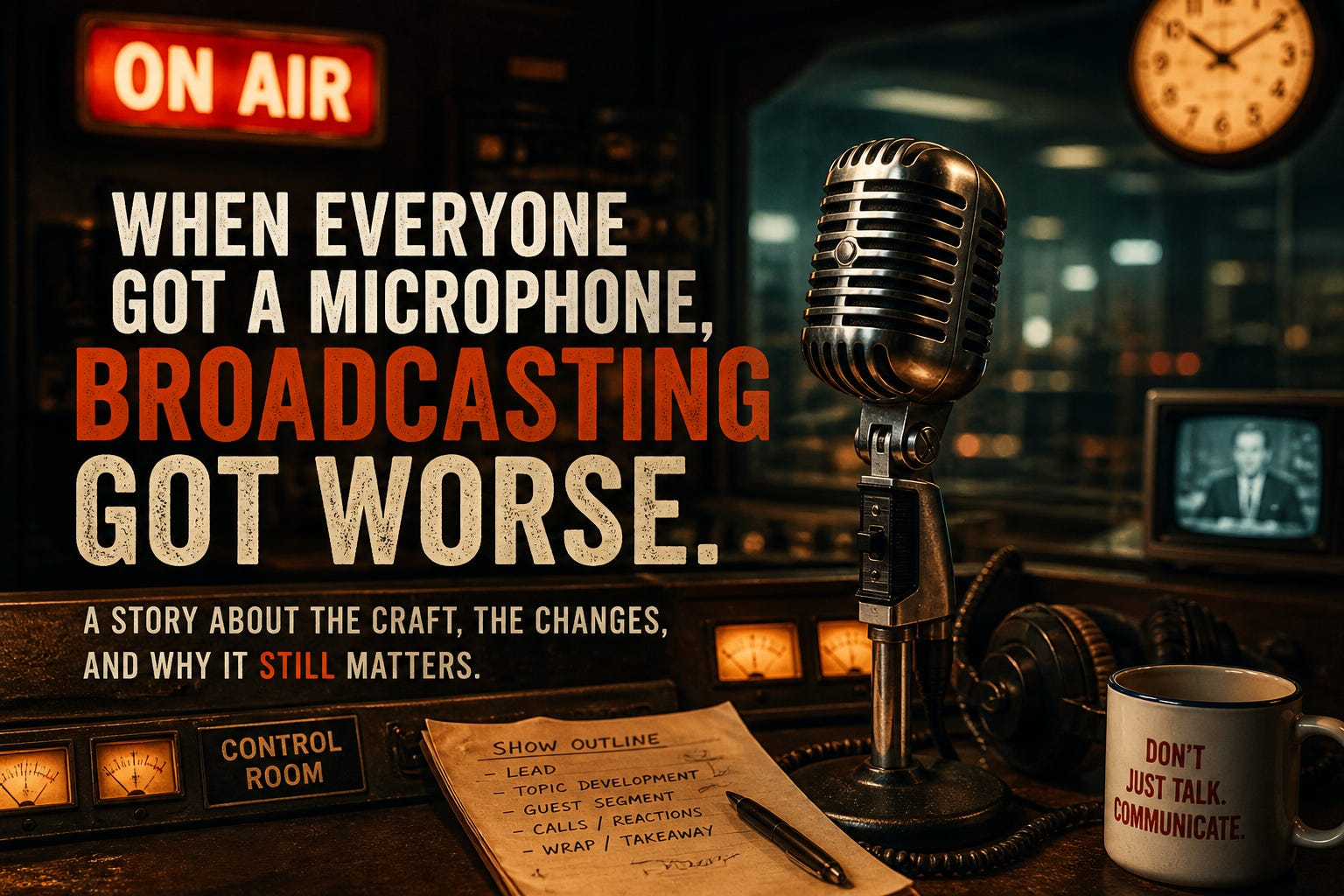
Everybody had a microphone.
At the same time, podcasts exploded. YouTube habits took over. The barrier to entry disappeared.
Now look — that part is great.
More opportunity. More voices. More creativity.
I mean that.
But there’s another side to it.
And I don’t think we say this enough:
Broadcasting skills are slipping.
Badly.
I hear it every day.
People talking with no direction.
Segments that don’t go anywhere.
No pacing. No structure. No understanding of how to actually build a show.
It’s just talking.
And somewhere along the way, we started acting like that was enough.
This drives me crazy. As a VSIN executive and former SiriusXM Sports VP said to me on air last week, “Who is teaching these people how to broadcast?”
The answer is likely: nobody.
Then I Went Back to School
Three years ago, I made a decision that probably surprised some people.
I went back and got my master’s in journalism and media from the University of Alabama.
The reason? I want to teach. I want to give back and pour into people with big dreams who just need direction and structure.
I had people do that for me as a young dreamer. Now I want to do it for the next generation.
I graduated from Alabama a year ago.
And since then, I’ve been asked to be part of the College of Communication & Information Sciences Board of Visitors.
That’s given me a different perspective.
A closer look at academia.
Some students still have those big dreams. They tend to be the ones who actually study journalism at places like Alabama.
But look around at what you get fed on your social media feeds. How many of those “broadcasters” do you think were actually trained properly in electronic journalism?
They know how to go viral — but little else.
That brings me to another issue.
The pursuit of viral clicks often leads to exaggerated content — and sometimes the spread of misinformation.
That pursuit of attention has contributed to the breakdown of modern journalism habits in America and beyond.
What We Used to Want
When I was coming up, we wanted to be great.
Not famous.
Great.
As a young broadcaster, mastering the art form was my greatest goal.
If you were in sports, you wanted to sound like Chris Berman or Dan Patrick.
Two of the best communicators and entertainers we’ve ever had.
If you leaned news, it was Connie Chung, Ann Curry, Dan Rather, Peter Jennings.
There was a standard.
There was an art to it.
Now?
A lot of young people want to be like their favorite social media creator.
Someone who built a massive following. Someone making real money off their brand — whether it’s influencers, personalities, or viral content machines.
And listen — no disrespect.
That’s a skill.
A real one.
Content creation is marketing. It’s creativity. It’s understanding an audience.
I respect it.
But it’s not the same thing as broadcasting.
And we’ve started to blur those lines.
The Part That Worries Me
When I speak to students — I was just at a digital media class at Middle Tennessee State — you can feel it.
They’re creative. They’re motivated. They want to make things.
But their frame of reference is different.
They’re chasing viral and followers.
We were chasing quality.
That doesn’t make them wrong.
But it does create a gap.
Because broadcasting — real broadcasting — is an art.
Guys like Vin Scully and Keith Jackson weren’t just talking.
They were painting pictures.
They understood pacing. Tone. Timing. Silence.
They understood communication at the highest level.
And communication itself is slipping.
People don’t talk on the phone as much anymore.
They don’t have as many face-to-face conversations.
Everything is quick. Texted. Posted. Skipped through.
That impacts how people communicate.
And if communication slips…
Broadcasting follows.
