

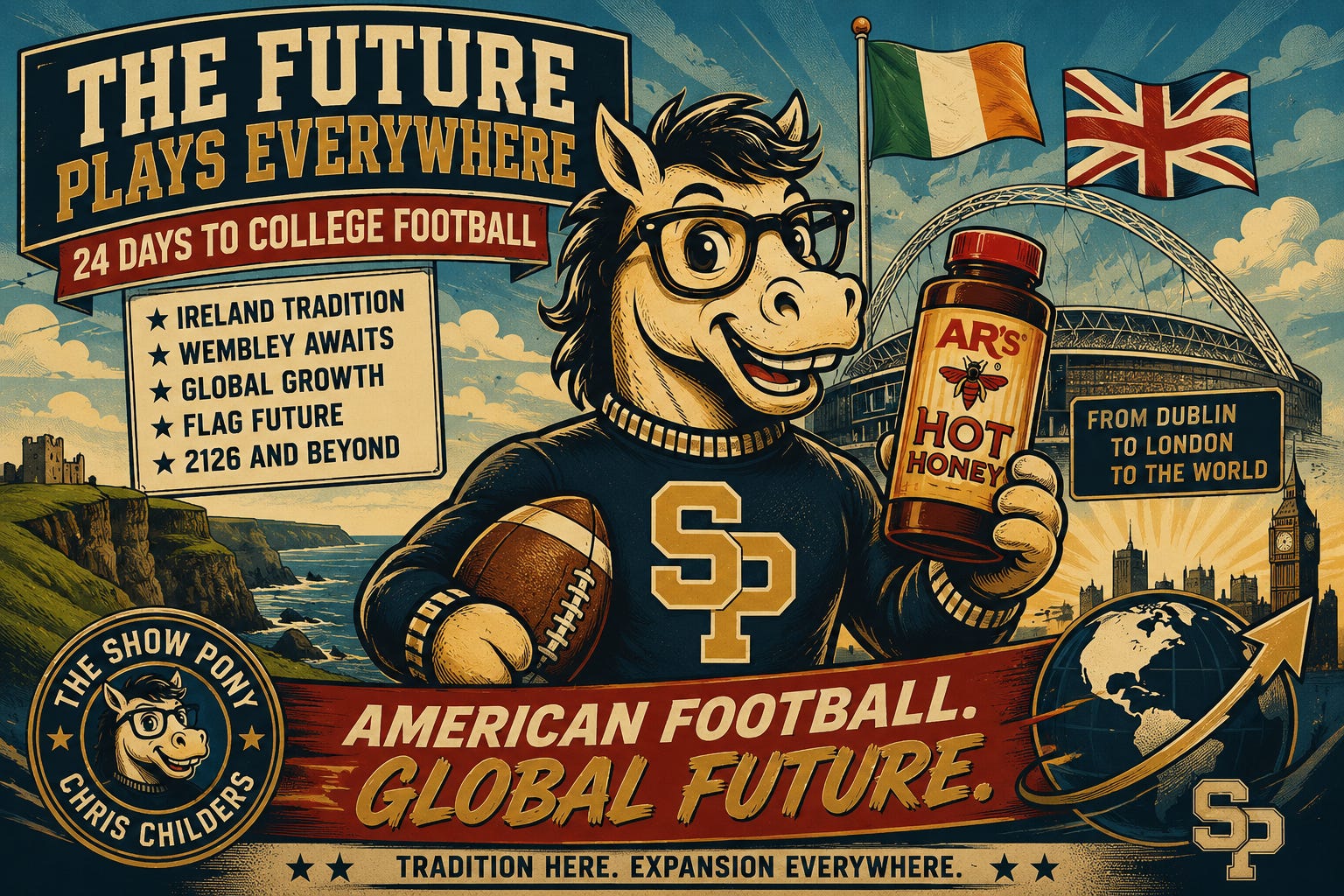
Twenty-four days.
That’s all that separates us from the return of college football.
Fittingly, the season won’t begin in Tuscaloosa, Columbus or Austin. It’ll begin more than 3,500 miles away.
TCU and North Carolina will kick off the 2026 season at Aviva Stadium in Dublin, Ireland, continuing what has quietly become one of the sport’s most fascinating traditions.
The Aer Lingus College Football Classic has become college football’s annual opening act overseas. The modern series has featured some intriguing matchups, including games between Nebraska and Northwestern, followed by Notre Dame-Navy, Georgia Tech-Florida State and Iowa State-Kansas State in recent years. It’s the product of years of work by Irish tourism officials, Aer Lingus and Irish American Events, who have made Dublin an annual destination for college football while showcasing Ireland to millions of American viewers.
It’s no longer viewed as a novelty.
It’s part of the calendar.
And it got me thinking.
We’ve spent decades talking about college football expanding conferences, television contracts and the College Football Playoff. Maybe we’ve been looking in the wrong direction.
Maybe the biggest expansion isn’t happening inside the United States.
Maybe it’s happening outside of it.
The NFL has been laying the foundation for international growth for years.
The International Series began in London in 2007. Today, regular-season games are played across London, Germany, Brazil, Spain and soon Australia. Roger Goodell has made global expansion one of the league’s defining priorities, with the NFL openly discussing a future where every franchise plays internationally on a rotating basis.
But the NFL isn’t just exporting games.
It’s exporting the sport itself.
