

(NEW) Order your Show Pony Merch Today!
Going to a Vanderbilt sporting event has changed exponentially — and it almost feels like it happened overnight.
I had not been out there to campus as much lately because I have been working six days a week, and most of the time I’m there during a football or basketball game. But I finally had a chance and took advantage.
For years, Vanderbilt just sort of existed. They were traditionally toward the bottom of the SEC in most anything that mattered, especially football. Sure, there were flirtations with greatness. Kevin Stallings had Memorial Gym rocking in the 2000s with NCAA Tournament teams that could absolutely score it. Before that, Jim Foster built a women’s basketball power on West End where Chantelle Anderson and Ashley McElhiney ran the show and made Vanderbilt a national brand.
But those moments felt like peaks in between long valleys — occasional sparkles in what was usually a long night of misery and anguish. The brand was “smart school in a football league.” Respectable academically. Plucky at times. Occasionally dangerous. But rarely dominant.
Not anymore.
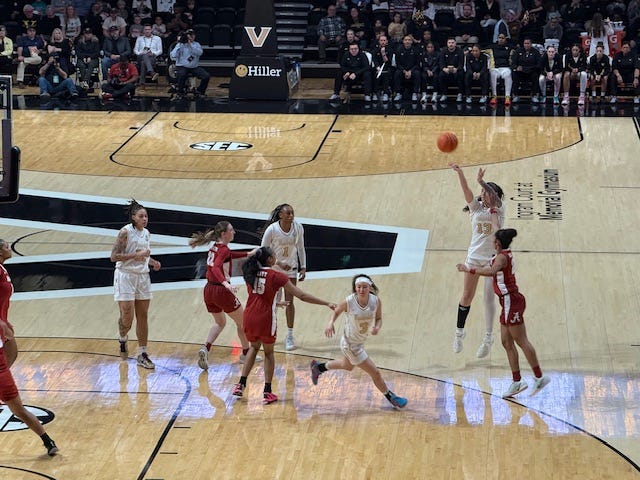
I took my daughter to the Commodores’ women’s basketball finale Thursday night against Alabama. What I witnessed with my own two eyes was a basketball team playing on its home floor that looked elite. Not just good. Not just an underdog with a puncher’s chance. Elite. A team loaded with depth and star power. A team capable of making a run to the Final Four.
Mikalya Blakes is unbelievable. Seeing a player of that caliber, recruited out of high school from New Jersey of all places, at a place like Vanderbilt is proof positive of how times have changed. We watched her put up 35 points against the Tide, including six threes. This lady’s game, as they say around here, is as “smooth as Tennessee Whiskey.” By the way, I am a Jack Daniel’s guy through and through! (Try the new Heritage Single Barrel. It’s amazing!)
They made a ranked Alabama team look like a low-major they were toying with in a preseason exhibition. The ball popped. The defense suffocated. The bench production never dipped. It was waves. It was confidence. It was dominance. They’ve got size, speed, shooters — everything. Vandy looked ELITE.
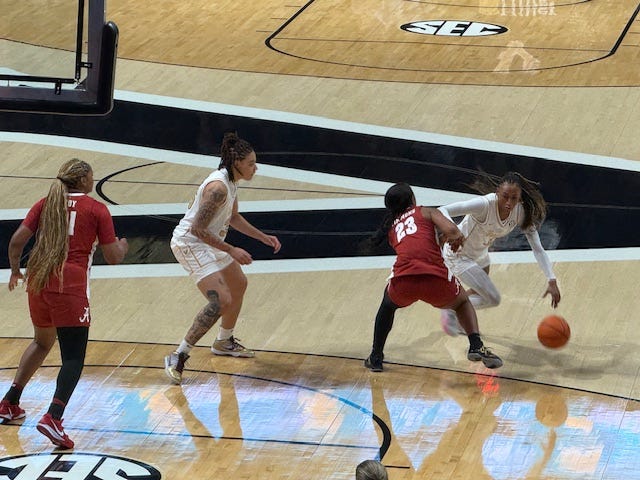
I was honestly blown away.
You almost have to see it to believe it. How the hell did this happen? At Vanderbilt?
The answer starts at the top.
When Vanderbilt hired Chancellor Daniel Diermeier in 2020, it signaled a shift not just in leadership style but in institutional priorities. Diermeier isn’t a former athlete, but he gets sports — how athletics can unite a campus, build community pride, and raise a university’s national profile in a way that textbooks alone never can. Since taking the helm, he’s said publicly that athletics is “as much part of Vanderbilt as the law school,” and he backed that up by launching Vandy United, a historic athletics investment campaign to the tune of $300 million aimed at dramatically enhancing facilities and the student-athlete experience across the board.
Not every university president or chancellor sees athletics that way. Diermeier does — and he made sure the people charged with running the programs had the freedom to make bold decisions.
That brings us to Candice Storey Lee — Vanderbilt’s vice chancellor for athletics and university affairs and athletic director. She’s not just a hire from outside with administrative chops; she bleeds black and gold. A three-time Vanderbilt graduate and former standout on the Commodores’ women’s basketball team, Lee captained teams that succeeded on the court and embodied Vanderbilt’s dual commitment to academics and athletics.
Lee’s leadership has been transformational. She’s the first female athletic director in Vanderbilt’s history — and the first Black woman to lead an SEC athletics program. Under her guidance, Vanderbilt has made strategic hires across major sports, launched massive fundraising campaigns, invested in facilities, and adopted a forward-leaning approach to recruiting — especially through the transfer portal.
Two years ago, Vanderbilt football was in crisis. Nearly 40 players left the program, and the Commodores found themselves desperate — short on depth, short on confidence, and short on wins. Coaches, players, and fans alike knew something had to change. Traditionally, Vanderbilt’s academic standards meant strict eligibility requirements limited the pool of players who could enroll and compete. That was a source of pride for the university — but on the football field, it was a competitive disadvantage in an era where the transfer portal has reshaped college rosters overnight. (Academic restrictions had been cited by fans as one reason for on-field struggles.)
So Lee did something many thought improbable: she pushed the chancellor to loosen some longstanding internal restrictions on transfers (while still preserving Vanderbilt’s academic prestige), understanding that if athletes could come and go through the portal without hurting the university’s U.S. News & World Report ranking, Vanderbilt could have both elite athletics and elite academics. Diermeier agreed — giving Lee and the football staff the green light to reimagine roster building.
That decision changed everything.
With new flexibility, Vanderbilt went after impact transfers — including Diego Pavia, whose arrival wasn’t just another name on a depth chart. Pavia brought leadership, explosiveness, and production at the quarterback position, propelling the Commodores into uncharted territory. He threw for over 3,000 yards and rushed for more than 800 in a historic breakout year, leading Vanderbilt to a 10-win season — the first in program history — and knocking off multiple ranked teams along the way. Pavia’s run put Vanderbilt on the map and made him a Heisman Trophy finalist, ultimately finishing second in the voting — a first for the school.
Football wasn’t just competitive — it was relevant again.
And this renaissance wasn’t limited to football.
On the hardwood, Shea Ralph — long a trusted assistant under women’s basketball legend Geno Auriemma at UConn — has taken the Commodores from a program that once struggled to compete in the SEC to one of the top-five teams in the country. Ralph built a culture of defense, teamwork, and relentless effort, crafting a roster that doesn’t just win — it dominates. Depth, versatility, and elite talent have vaulted Vanderbilt into national consideration, and Memorial Gym — once a quirky home — has become a fortress.
Meanwhile, Mark Byington has revitalized the men’s basketball program. After inheriting a team coming off a 9–23 season, he steered Vanderbilt to a 20-win campaign and an NCAA Tournament berth. This season’s 16–0 start and national ranking have made Commodore basketball must-see TV. The offense is modern and efficient; the defense is connected and hungry. That’s not hype — that’s legitimate national relevance, earning respect from fans and analysts alike. They may be struggling a bit toward March — as Kentucky just kicked their butts five ways to Saturday — but this team is good and incredibly improved in short order.
What we saw Thursday night wasn’t a fluke. It was the byproduct of a strategic institutional commitment — one that recognized athletics could be a front porch to the university, a way to draw the nation’s attention, energize alumni, and amplify Vanderbilt’s brand without sacrificing its academic excellence.
That’s the real shift.
Vanderbilt used to be the SEC’s afterthought. Now? They’re appointment viewing.
How did this happen?
Smart hires. Bold institutional leadership. A chancellor who wasn’t afraid to shift old paradigms. An athletic director who knows both the value of discipline and the power of adaptation. And players and coaches who seized the opportunity to rewrite expectations.
From 40 players leaving a desperate football program to a possible playoff contender — from dormant basketball reputations to Top-5 national rankings — Vanderbilt athletics has flipped the script.
And it looks like the chapter we’re living in is just the beginning.
Ditto Scott Dolson and Pam Whitten at IU, Athletic Director and President respectively at Indiana University. University leaders must understand that the dynamics of college sports has been transformed forever. More changes to come.
The right coaches and the right culture matter more than ever now. Not everyone is cut out to coach and foster a workable culture for today’s translucent athlete. I mean the athletes are basically part of the college sports multiverse and can exist on more than one team now for a period of time, they can hop in and out of the portal like they are holding all 6 infinity stones, and the can basically manage their own playing time now, even though they are making millions of dollars. Who are we kidding by not calling these athletes employees and these contracts legitimate employee agreements?? Hi…I’m Mr. Rogers. No I’m not…just because I say it and try to make you believe it doesn’t make it true. You’re the best Pony! Glad to have some material to read and I’d love to look into the radio “counseling” or “coaching”. Enjoy your Sunday!