

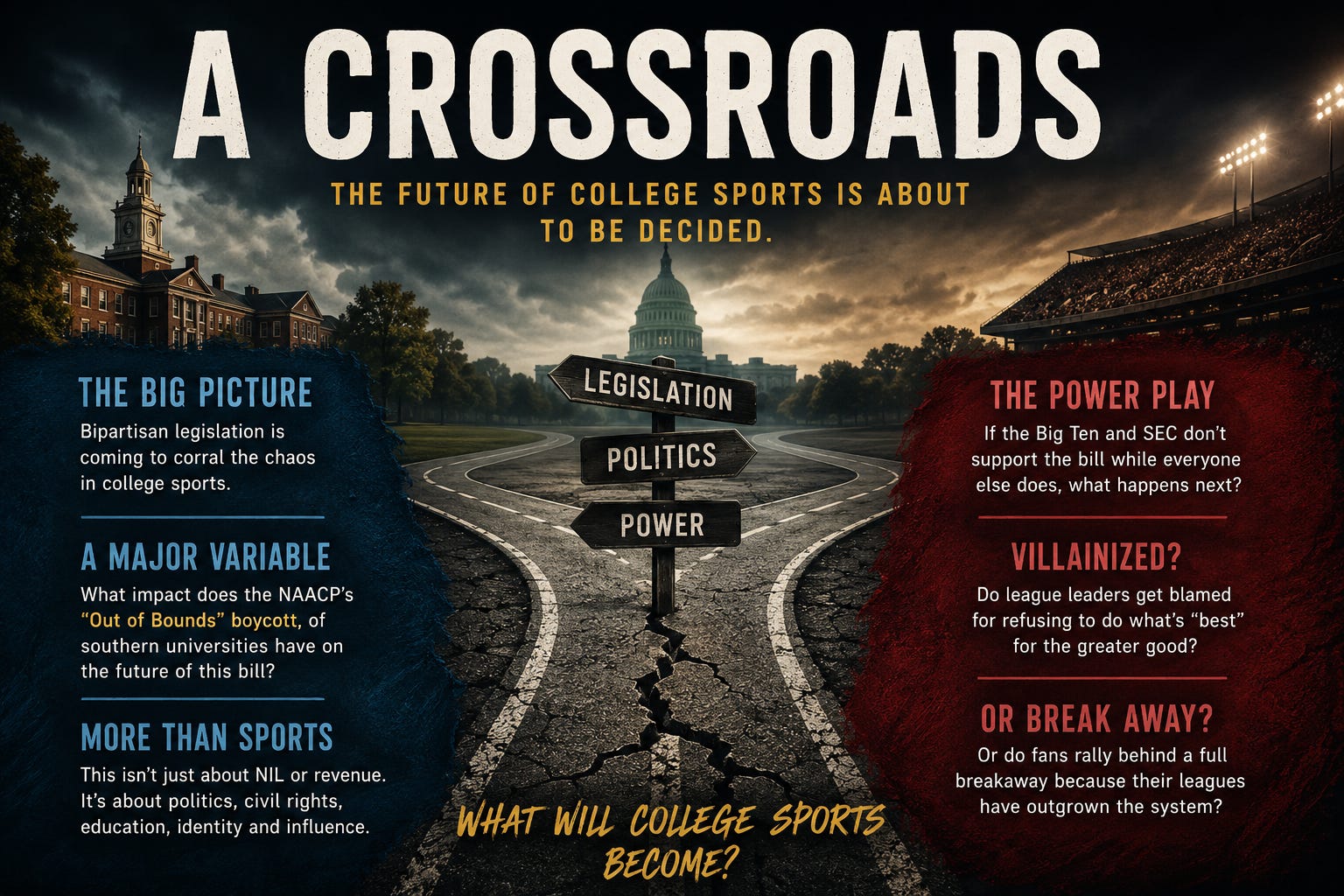
So we know bi-partisan legislation is likely to be introduced soon in an attempt to corral the current direction of college sports. Yahoo and the likes were reporting as such within the last few hours.
Ted Cruz and Maria Cantwell stepping into this space tells you something important immediately: college sports has officially become too big, too political, too financially significant and too chaotic for Washington to ignore.
That alone is fascinating. Sad as heck, honestly. Fascinating, none the less. Almost a human experiment of sorts. An example of what happens when “Anarchy Rules” A fmous slogan used by the punk scene in the 90’s. The punk rockers may have not imagined anarchy would exist in its purest form in 2026 college football, but here we are, alas.
Too many people with power who don’t have the greater good at heart. When the Alston ruling stripped the NCAA of its governing power, we landed in our version of anarchy.
But what’s even more fascinating are the variables currently at play around this legislation and what they could ultimately mean for the future structure of college athletics.
For starters, what impact does the NAACP’s newly announced “Out of Bounds” boycott campaign against major southern athletic programs have on this entire conversation?
The NAACP is urging Black athletes, fans and supporters to withhold support from public universities in several southern states following recent voting rights and redistricting battles tied to the Supreme Court’s Louisiana v. Callais decision.
That suddenly adds an entirely different layer to the college sports debate.
Because now this isn’t just about NIL, revenue sharing, employment status and conference power anymore. Politics, civil rights, regional identity and the economic influence of college athletics are all colliding at the exact same time Congress is preparing to step into the sport.
That may sound unrelated on the surface, but is it? College athletics has always reflected broader societal conversations whether people want to admit it or not. Politics, economics, regional identity, race, education, labor rights and culture are all intertwined inside this sport now. They can’t be separated anymore.
Then there’s the elephant in the room.
What happens if the Big Ten and SEC ultimately refuse to support whatever framework comes out of this legislation while everyone else falls in line?
That’s where things become extremely interesting.
Do the leaders of those conferences become villainized by fans across the rest of college sports for refusing to do what’s best for the greater good? Do people begin to openly view the SEC and Big Ten as entities more interested in protecting power and revenue than preserving the ecosystem itself?
Or does the exact opposite happen?
Do supporters of those leagues rally behind a full breakaway because they believe their conferences have outgrown the current structure entirely?
Because honestly, we are approaching a moment where college sports may have to decide what it wants to be.
Is this still a broad national collegiate model where the health of the overall sport matters?
Or are we rapidly heading toward a future where the top brands separate completely and operate under a pseudo-professional super league structure?
That’s the crossroads we’re approaching.
And the scary part? I’m not entirely sure anyone truly knows what happens next if the divide becomes permanent.
College sports aren’t just changing anymore.
It’s fighting over what it even wants to become.
Let’s hope we get some version of the way things used to be.
A world where traditions, rivalries, the bands, the fans and the students matter above all else.
Especially, money.